A 3-month program led by Dr. Roshani Sanghani for people who feel well, but want a clinical read on where their metabolism is heading — especially with family history, belly fat that will not shift, fatty liver, pre-diabetes, or rising triglycerides.
Dr. Roshani Sanghani·American Board-Certified Endocrinologist·★ 4.9·202Google reviews·20+ years
Meet Dr. Roshani
A fasting glucose that moved from 80 to 90 to 99 over five years may be technically normal every time. But it is still heading in one direction.
Belly fat that will not shift is one visible clue. The fat that matters more is the visceral fat around your organs — and it is what drives fatty liver, rising triglycerides, and insulin resistance. It can sit there at a waistline that looks completely normal.
Fasting insulin, triglyceride-to-HDL ratio, liver enzymes, body composition, and waist-to-hip ratio can reveal compensation before a diagnosis appears. These markers are often missing from a standard checkup, or reviewed one by one instead of as a pattern.
Dr. Roshani takes this personally — her own pre-diabetes was found before any symptom appeared. That is why she treats an early marker change as something to investigate, not something to wave away.
If you have family history, belly fat that does not shift, fatigue that does not match your schedule, or markers your doctor calls “borderline,” the useful question is not whether you are sick. It is whether your current trajectory is one you want to keep.
It runs in two parts. First, Dr. Roshani reads your markers together, not one at a time — because a single number can sit inside the normal range while several others are quietly drifting. Then she builds the lifestyle foundation that turns that drift around.
First, she finds out where you actually stand.
Before any lifestyle change begins, Dr. Roshani reviews your full metabolic panel alongside your lifestyle questionnaire and app data. The question is not “are the numbers in range?” — it is “which way are they moving, and what would change that?”
Markers she reads together
Glucose trend
Fasting glucose and HbA1c over time
Insulin signal
Fasting insulin before glucose rises
Lipid pattern
Triglycerides, HDL, and their ratio
Liver signal
Liver enzymes and fatty liver risk
Body composition
Waist-to-hip ratio and visceral fat pattern
Daily context
Sleep, stress, movement, medications, and food data
Then, she builds the foundation — in the right order.
Start with the food that drives insulin.
Adequate protein, reduced refined carbohydrates, and understanding what Indian foods do to insulin specifically. This is where almost every preventive patient begins, because the typical Indian diet is heavily carbohydrate-dominant even for people who eat carefully. Dr. Roshani works with the patient’s existing kitchen and real life.
Poor sleep moves glucose — even when your eating hasn’t changed.
Cut a healthy person’s sleep to about four hours a night and, within days, their blood sugar control measurably worsens. That has been shown in volunteers with no metabolic risk at all. For a preventive patient, that makes sleep a clinical priority — not a soft suggestion.
Stress shows up in insulin, sleep, and abdominal fat.
Chronic elevated cortisol worsens insulin resistance, disrupts sleep, and drives abdominal fat storage. For the high-performing professional carrying significant work and family load, stress is not an abstract concept. It is a metabolic driver that is either being managed or quietly accumulating risk.
Muscle is the body’s glucose taker — not just a fitness goal.
Muscle clears most of the glucose from a meal — by some measures 60 to 90 percent of it. Resistance training builds that capacity, and it compounds over decades. For a preventive patient, building muscle now is one of the most direct investments in long-term metabolic health.
On medication
Many preventive patients are not on medication — and acting early is often what keeps it that way. For patients who are on statins, blood pressure medication, or early-stage diabetes medication, Dr. Roshani manages medications directly for India-based patients and provides clinical guidance for international patients’ local prescribers.
Dr. Roshani does not hand patients a generic diet chart. She helps them understand how different foods affect insulin, the liver, and the metabolic trajectory — using the food they actually eat. Vegetarian, non-vegetarian, Jain, eggetarian, vegan, keto, or carnivore.
Family history matters. But families also share kitchens, meal timing, stress rhythms, and food defaults. Reisaan helps patients see what may be inherited, what may be learned, and what can actually be changed.
The plan has to survive family meals, travel, preferences, and the food patients already know how to cook.
A cardiologist colleague of Dr. Roshani — Dr. Aashish Contractor, medical director of the Mumbai Marathon for over a decade — treats diabetes as a heart-disease equivalent. About half of his cardiac patients also have diabetes. Both conditions share one root: insulin resistance. And about 90 percent of the time, he says, managing the modifiable risk factors brings cardiac risk down.
For people of Indian origin, insulin resistance, abdominal fat, triglycerides, blood pressure, sleep, and stress can start moving before one dramatic number appears. The risk pattern can show up at lower body weights and younger ages than many standard thresholds suggest.
A young woman with PCOS, a professional with a potbelly and a “normal” BMI, or someone with family history of diabetes and heart disease may all need a different kind of review: not just “is this number normal?” but “what is this pattern becoming?”
Dr. Roshani’s position: adults of Indian origin should understand their metabolic markers early, especially when they feel completely well.
A note: Most Reisaan patients are of Indian origin, living across 12+ countries. Dr. Roshani also welcomes patients from other backgrounds who want this approach.
Family history
CVD, diabetes, hypertension, thyroid
Insulin resistance and fatty liver improved · Without medication
Strong family history of every major chronic condition. Supriya joined before a diagnosis and changed the trajectory.
“I saw that the medication and symptom management I had witnessed with my family members had never left anyone better off. In Dr. Sanghani, I found not only the most qualified guide I could have hoped for, but a doctor who actually advocated for me — and taught me to advocate for myself. My health is totally transformed — all without medication.”
Supriya
Prevention — Family History
Supriya
Prevention — Family History
Insulin resistance and fatty liver improved · Without medication
Strong family history of every major chronic condition. Supriya joined before a diagnosis and changed the trajectory.
“I saw that the medication and symptom management I had witnessed with my family members had never left anyone better off. In Dr. Sanghani, I found not only the most qualified guide I could have hoped for, but a doctor who actually advocated for me — and taught me to advocate for myself. My health is totally transformed — all without medication.”
2 years
Improved markers · Managing independently
Her GP recommended statins and diabetes medication. Dr. Roshani reviewed the full picture and began with lifestyle. Two years later: managing independently.
“From the beginning I was very attracted to Dr. Roshani's straight forward attitude and also her strict refusal to spoon feed me in my journey of lifestyle change. She refused to give me a daily diet chart but instead gave me an app. It is now almost two years since I have been under her guidance. My HbA1c and cholesterol levels are much better. I am confident that I can now handle things on my own.”
Prachi
Prevention — Cholesterol & Blood Sugar
Prachi
Prevention — Cholesterol & Blood Sugar
Improved markers · Managing independently
Her GP recommended statins and diabetes medication. Dr. Roshani reviewed the full picture and began with lifestyle. Two years later: managing independently.
“From the beginning I was very attracted to Dr. Roshani's straight forward attitude and also her strict refusal to spoon feed me in my journey of lifestyle change. She refused to give me a daily diet chart but instead gave me an app. It is now almost two years since I have been under her guidance. My HbA1c and cholesterol levels are much better. I am confident that I can now handle things on my own.”
Belly fat reduced
Cardiometabolic risk pattern improved
Nilesh wanted an approach that actually made sense. As the belly fat reduced, his risk pattern changed with it.
“Everything they explained actually made sense. Their philosophy is refreshingly back-to-basics. After applying the principles, I lost most of my pot belly quickly. As a bonus, I was also significantly reducing my risk of cardiovascular problems without even targeting them directly.”
Nilesh
Prevention — Metabolic Risk
Nilesh
Prevention — Metabolic Risk
Cardiometabolic risk pattern improved
Nilesh wanted an approach that actually made sense. As the belly fat reduced, his risk pattern changed with it.
“Everything they explained actually made sense. Their philosophy is refreshingly back-to-basics. After applying the principles, I lost most of my pot belly quickly. As a bonus, I was also significantly reducing my risk of cardiovascular problems without even targeting them directly.”
Lipid profile improved
Best shape of his life
Pratik's GP recommended statins. He chose Reisaan. His lipid profile improved significantly.
“By the end of the program I managed to significantly improve my lipid profile — including reversing some key metrics — and was in the best shape of my life. The focus was always on holistic health versus looking at an issue in a silo.”
Pratik
Prevention — High Cholesterol
Pratik
Prevention — High Cholesterol
Best shape of his life
Pratik's GP recommended statins. He chose Reisaan. His lipid profile improved significantly.
“By the end of the program I managed to significantly improve my lipid profile — including reversing some key metrics — and was in the best shape of my life. The focus was always on holistic health versus looking at an issue in a silo.”
When prevention works, the win is quiet. It is the diagnosis that did not arrive. The medication that was not needed. The risk that was caught while it was still small enough to change.

“(On the book) Dr. Roshani has simplified the steps of reversing metabolic disease and covered every aspect of lifestyle change that people need. A potential life changer.”
— Dr. Jason Fung, NYT Bestselling Author, The Obesity Code and The Diabetes Code
Who leads your care
American Board-Certified in Endocrinology, Diabetes, and Metabolism
Dr. Roshani has been practicing lifestyle-first endocrinology since 2013. Preventive cardiometabolic health is not an add-on to her clinical practice. It is where her own story began.
In 2013, Dr. Roshani found pre-diabetes in herself — HbA1c 6.3, no symptoms, family history on both sides. She was already an endocrinologist. More than a decade later: no diabetes. Not because her genes changed. Because the trajectory changed. She shares this not as a promise, but as the clinical reason she takes early warning signs seriously.
American Board-Certified in Endocrinology, Diabetes, and Metabolism·American Board-Certified in Internal Medicine·MINT-Certified Motivational Interviewing Trainer·Certified Personal Trainer·Author, Turn Around Diabetes (2024)·KEM Hospital, Mumbai · Internal Medicine training (US)
View full credentials →First Consultation
₹4,000 / USD 60 · In person in Mumbai or online by video
A clinical review of your labs, medications, history, and daily context after Dr. Roshani’s team has reviewed your record.
Decision
With a clear picture of your metabolic state and the Reisaan approach, you decide whether to continue into the 3-month program.
Program
Alternate consultations — Dr. Roshani and her team, supported by app data and weekday Telegram support between sessions.
Independence
The goal is to leave with the knowledge and habits to keep managing your metabolic health independently.
First Consultation
₹4,000 / USD 60 · In person in Mumbai or online by video
A clinical review of your labs, medications, history, and daily context after Dr. Roshani’s team has reviewed your record.
Decision
With a clear picture of your metabolic state and the Reisaan approach, you decide whether to continue into the 3-month program.
Program
Alternate consultations — Dr. Roshani and her team, supported by app data and weekday Telegram support between sessions.
Independence
The goal is to leave with the knowledge and habits to keep managing your metabolic health independently.
What happens in the First Consultation
Dr. Roshani’s team spends more than 30 minutes on your record before you ever speak. They see your whole week, not a summary of it. So the consultation itself is not spent gathering facts — it is spent making sense of them with you.
You leave with a clinical picture of where you stand metabolically — not a vague “keep an eye on it.” Then you decide whether to continue.
Alternate consultations
Dr. Roshani joins alternate consultations with her team.
Daily chat support
Via Telegram, Monday to Friday, between consultations.
Dr. Roshani’s video course
Dr. Roshani's course. 3 months access.
Reisaan app
Log your food, sleep, exercise, glucose, and more daily. Your data feeds directly into Dr. Roshani’s clinical record — so every consultation starts with what actually happened, not what you remember.
Medication management
India: managed directly. International: guidance for your prescriber.
Community
A coached patient community during the program.
Most patients finish the program knowing enough to manage independently. If you want continued clinical involvement, maintenance options are available.
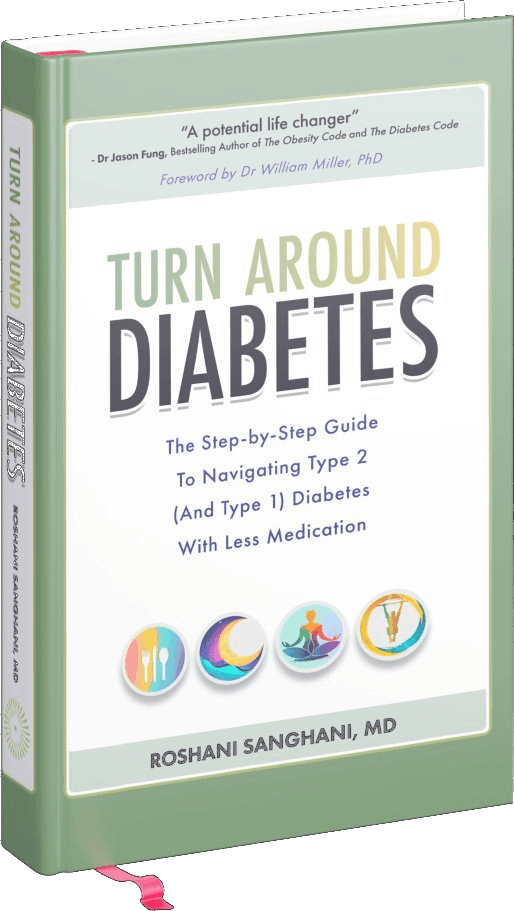
Turn Around Diabetes explains the same metabolic process this program looks for early: insulin resistance, fatty liver, rising triglycerides, and the lifestyle foundation that changes the trajectory before disease is established.
Endorsed by: Dr. Eric Westman (Duke University) · Dr. Medha Munshi (Harvard Medical School) · Benjamin Bikman, PhD · William R. Miller, PhD (Co-founder, Motivational Interviewing) · Mark Cucuzzella, MD (WVU School of Medicine)
Read more about the book →Have a family history of Type 2 Diabetes, heart disease, PCOS, fatty liver, or metabolic syndrome — and want to change the trajectory before it repeats
Are noticing early warning signs — belly fat that does not shift, fatigue, creeping blood markers, a doctor who says "borderline" — and want to act before it becomes a diagnosis
Feel well but want an endocrinologist to look at your full metabolic picture and tell you where you actually stand
Are health-conscious and doing a lot already — but want a qualified clinical eye to validate your approach and fill the gaps you cannot see on your own
Want to understand your own metabolic biology — not just follow generic wellness advice
Want a doctor who understands your food, your culture, and your context
A willingness to understand the why, not only follow a chart
Enough daily logging to let Dr. Roshani’s team see what is actually happening
Openness to changing sleep, stress, food, and movement together when the pattern calls for it
If that is not what you want right now, the First Consultation can still help you understand whether Reisaan is the right fit.
A note on Type 2 Diabetes
If you already have a Type 2 Diabetes diagnosis, visit our Type 2 Diabetes Remission program — the approach is the same, but the clinical starting point and medication management are different.
Type 2 Diabetes Remission program →Metabolic syndrome is a cluster of insulin resistance, abdominal fat, elevated blood pressure, abnormal lipids, and impaired blood glucose regulation. It raises the risk of Type 2 Diabetes, heart disease, fatty liver, and other chronic conditions.
For people of Indian origin, this pattern can appear at lower body weights and younger ages than many standard thresholds suggest. Dr. Roshani looks at the full pattern because many people with metabolic risk feel completely well. Feeling fine is not the same as knowing where the metabolic trajectory is heading.
Because metabolic risk can build quietly for years before symptoms appear. A person can feel well while fasting insulin is rising, liver enzymes are creeping up, triglycerides are moving in the wrong direction, or waist-to-hip ratio is changing.
Dr. Roshani's preventive approach looks at those early signals together, not in isolation — and treats an early marker change as something to investigate, not wave away. It is the approach she applied to her own pre-diabetes in 2013.
Dr. Roshani reviews the full metabolic panel — HbA1c, fasting glucose, fasting insulin, the triglyceride-to-HDL ratio, liver enzymes, waist-to-hip ratio, body composition, and blood pressure — and reads them together rather than one at a time.
What she is looking for is direction. A number inside the normal range today can still be drifting year over year, and one marker on its own can miss a pattern that several together would show. In the First Consultation, Dr. Roshani goes through your own results with you and what they mean.
You do not need to wait until a number crosses a line. Start with a First Consultation and let Dr. Roshani look at the whole pattern. If it looks good, she will tell you that too.
In person in Mumbai or online by video